Is My Quote a Scam?
Instant sanity check on any quote against verified pricing for your zip.

A CSIA certified chimney sweep is an operator who has passed the Chimney Safety Institute of America's written certification exam, maintains ongoing continuing education, and has signed the CSIA code of ethics. When you see "CSIA Certified" on a truck, a business card, or a directory listing, that's the credential being referenced.
The credential matters more than most home-services certifications because the chimney industry has almost no mandatory regulation — 49 of 50 US states do not require any chimney-specific license to operate. CSIA is the closest thing the industry has to a national quality floor. But the phrase that appears repeatedly in the Voice of Customer research is "necessary but not sufficient," and that phrase captures both the value and the limit of the certification in a single sentence.
This article covers what CSIA is, what the certification actually guarantees, what it does not guarantee, how to verify a specific sweep's certification status, and how to use CSIA certification as one input among several when choosing an operator.
The Chimney Safety Institute of America is a 501(c)(3) non-profit organisation based in Plainfield, Indiana, founded in 1983. It is the primary certification body for the US chimney service industry and a frequent reference point in NFPA 211, the national fire code standard for chimneys. CSIA is not a government agency and does not hold statutory authority, but the industry treats its standards as de facto requirements for professional practice.
CSIA's core functions are:
CSIA is distinct from the National Chimney Sweep Guild (NCSG), which is a separate industry association focused on trade advocacy and member business services. An operator can be an NCSG member without being CSIA-certified, or CSIA-certified without being an NCSG member, or both. The relevant question for consumers is the individual technician's CSIA certification, not the company's NCSG membership.
Becoming CSIA certified is not trivial. An operator going through the process has to:
The combination of written exam plus ongoing CE plus annual fee means CSIA certification is not a one-time hurdle. An operator has to keep investing in the credential year after year to maintain it. That ongoing investment is itself a quality signal — operators willing to pay the fees and complete the CE each year are demonstrating sustained professional commitment.
CSIA offers several distinct credentials. The one most homeowners care about is the Certified Chimney Sweep, but the others are worth knowing.
Certified Chimney Sweep (CCS). The core credential. Covers inspection levels, sweep methodology, and combustion systems. This is the credential most referenced in consumer-facing contexts and the one verified by the CSIA search directory.
Certified Chimney Reliner (CCR). A specialty credential for technicians who install and reline chimney flues. Relevant if you are hiring for liner installation or replacement specifically.
Certified Chimney Professional (CCP). A more advanced credential for technicians with broader scope across sweeping, inspection, and repair work.
Certified Dryer Exhaust Technician (CDET). Separate certification for clothes-dryer vent cleaning, which some chimney sweeps offer as an adjacent service.
Master Chimney Sweep (MCS). The top-tier credential, requiring multiple years of experience as a CCS plus additional advanced testing. Relatively uncommon.
National Fireplace Institute (NFI) certifications. NFI is a separate but related body that certifies specifically for gas, wood, and pellet appliance installation and service. An operator servicing a gas fireplace may be NFI-certified rather than (or in addition to) CSIA-certified. For gas-specific work, NFI Gas Specialist certification is as relevant as CSIA.
For a standard chimney sweep or inspection on a wood-burning system, "CCS" is the primary credential to verify. For a gas fireplace, NFI Gas certification is equally or more relevant. For a liner job, CCR adds specific expertise.
Verification is one step, and the step is specific: search.csia.org. This is the official CSIA search directory.
The UX is unfortunately poor. The portal is a JavaScript single-page application that accepts only ZIP code input (no name-based search that returns reliable results across states, no state-level filtering, no company-name search). You enter a ZIP, wait for results to load, and browse the returned list of certified technicians in that area. Certification status and expiration date are displayed for each result.
If an operator claims CSIA certification, match three things against the directory: the individual technician's name (certification is held by the individual, not the company), the certification number (each certified sweep has a unique CSIA number), and the expiration date (certifications lapse if CE isn't completed). All three should match the CSIA portal record exactly.
On FindChimneySweepers, we automate this verification. Our platform matches operator records against the official CSIA JSON dataset using business-name and phone-number fuzzy matching. Where a match is confirmed, a CSIA badge is displayed on the operator's listing automatically. No operator can self-claim certification without being in the authoritative CSIA dataset. This inverts the "take their word for it" problem and is one of the specific reasons this directory exists.
The flip side: an operator who claims "we're CSIA certified" on their website but cannot be found in the CSIA search portal is misrepresenting their status — they may have let their certification lapse, or hold some non-CSIA credential they are presenting as CSIA. None of those outcomes favor you.
Be specific about what the credential actually promises.
Baseline technical knowledge. A CSIA-certified sweep has passed a written exam covering NFPA 211 inspection levels, sweep methodology, combustion chemistry, creosote formation and grading, masonry defects, liner systems, and draft dynamics. They know the difference between a Level 1 and Level 2 inspection without having to look it up. They understand why wood moisture content matters. They know what "Grade 3 glazed creosote" means. That baseline is not guaranteed for an uncertified operator.
Agreement to industry standards. Certification requires signing the CSIA Code of Ethics, which commits the operator to honest service, transparent pricing, NFPA 211-compliant scope of work, and proper industry practice. Violation of the code is grounds for certification revocation. The code is enforceable — CSIA investigates complaints and has revoked certifications for conduct violations.
Ongoing professional engagement. The continuing education requirement means a certified operator in 2026 has been exposed to the latest code updates, product innovations, and best-practice guidance. Uncertified operators may be operating on knowledge from a decade ago.
Exam-verified methodology. The certification exam covers specific technical topics. A certified operator has demonstrated exam-level knowledge of, for example, the correct Level 2 inspection protocol, which includes video-camera scanning. An uncertified operator may not know the protocol at all.
This is the part that matters most.
Honest pricing on any given job. CSIA certification does not prevent an operator from quoting $5,000 on a chimney that needs $1,500 of work. The certification exam is about technical competence, not about pricing psychology. A certified operator who has chosen to adopt a high-pressure sales model can still do significant consumer harm.
Quality of work on your specific visit. The exam tested knowledge; it did not follow the operator around for a decade verifying that every job they did was performed to spec. A certified sweep can still skip the rooftop access, can still leave the flue half-cleaned, can still bill for services that weren't actually performed.
Insurance coverage. CSIA certification is not insurance. An operator can be CSIA-certified and uninsured simultaneously. You need to verify insurance separately by requesting a Certificate of Insurance.
Long local track record. A sweep can get CSIA certified in their first year of operation. Certification does not imply tenure. A 30-year unlisted operator may be more reliable than a certified one in their second year.
State licensing compliance. Only North Carolina mandates chimney-specific certification. In all other states, CSIA certification is voluntary and has no regulatory force. In states that require general contractor licensing for certain repairs, CSIA certification does not substitute for that state license.
Freedom from upselling pressure. The certification does not police sales tactics on individual jobs. A certified operator can still employ the bait-and-switch "deep clean" upsell pattern, can still inflate Level 2 inspection findings, can still push unnecessary repairs. The code of ethics disapproves of these behaviors but cannot detect them in real time on your chimney.
The VoC research captures this with the phrase "necessary but not sufficient" — appearing in eight-plus distinct threads. Certified operators can still recommend unnecessary services. Uncertified operators can still be excellent. Certification is a filter that raises the base rate of competence; it does not eliminate variance.
| Factor | CSIA Certified | Not CSIA Certified |
|---|---|---|
| Passed written exam on chimney systems | Yes | Unknown |
| Completed continuing education | Yes (3-year cycle) | Unknown |
| Signed CSIA Code of Ethics | Yes | No |
| Verified in search.csia.org | Yes | No |
| Knows NFPA 211 inspection protocol | Yes | Possibly |
| Carries insurance | Separate verification needed | Separate verification needed |
| Fair pricing on your job | Not guaranteed | Not guaranteed |
| Quality of work on your specific visit | Not guaranteed | Not guaranteed |
| Long local track record | Not guaranteed | Not guaranteed |
| State license compliance | Not implied (except NC) | Not implied (except NC) |
Reading this table correctly: certification raises the floor on technical knowledge but doesn't raise the ceiling on service quality. You still need the other verification steps from find-honest-sweep.
The National Chimney Sweep Guild is a trade association. Membership is open to chimney service companies and is primarily a business-services relationship — NCSG members receive trade publications, conference access, group insurance rates, and advocacy representation. Membership is a company-level commitment.
CSIA certification is an individual technician credential. A company with NCSG membership does not, by virtue of the membership, have any CSIA-certified technicians. Conversely, an individually CSIA-certified sweep may work at a company with no NCSG affiliation.
Both badges appear on chimney company websites, sometimes side-by-side, and homeowners often conflate them. For consumer verification purposes, CSIA certification of the specific technician doing your work is the relevant credential. NCSG membership of the company is a trade-association signal but not a quality or competence indicator.
North Carolina is the only US state that requires chimney-specific certification for sweep operators. NC regulations require NCSG certification under the state fire code. All other 49 states regulate chimney work under general contractor frameworks, which typically means:
The practical implication: in most states, an uncertified operator can legally perform chimney sweeping and Level 1 inspections with no state oversight. Voluntary certifications (CSIA, NFI) and insurance are therefore doing all the work that would normally be done by state licensing in other trades. This is why the consumer verification burden is higher for chimney services than for, say, electrical or plumbing work.
Our platform imports the CSIA certification data directly from the official dataset and auto-matches it against our operator database. Matching is done on business name fuzzy similarity plus phone number last-seven-digits overlap. A match scores the operator for a CSIA badge that displays automatically on their listing.
Critically, this data flow is one-way: operators cannot self-report CSIA status on their listing. If they claim certification on their website but are not in the official CSIA dataset, they get no badge from us. This structurally prevents the "we're CSIA certified" lie that appears on scam-operator websites, where operators claim certifications they do not actually hold.
When the CSIA dataset updates, we re-run the match. Operators whose certifications lapse lose their CSIA badge automatically. This is part of the rationale for the FindChimneySweepers model — certification data is authoritative and directly tied to the underlying CSIA source, not to operator self-report.
CSIA certification raises the base rate of competence and ethics. It does not guarantee the specific job on your house will be handled honestly or thoroughly.
The practical strategy: filter your initial shortlist to CSIA-certified operators (use the FindChimneySweepers directory or search.csia.org). Then apply the other verification layers from find-honest-sweep — insurance, branded vehicle, camera use, pricing transparency, local track record, second-opinion tolerance. The layered approach catches the operators who are certified but still use extractive pricing, and also catches the uncertified operators who may be excellent but can't prove it through a single credential.
No single signal is load-bearing on its own. CSIA is one of the strongest single signals you can use, but it works best combined with the others.
Browse 30+ guides, or jump straight to verified operators in your state.

The 10 trust signals that separate honest chimney sweeps from scammers. Vetting questions, verification steps, and how to avoid paying 10x market rate.
The 7 chimney sweep scam patterns — bait-and-switch deep clean upsell vs legitimate chemical treatment, fake Level 2, multi-alias SEO, unnecessary relining.
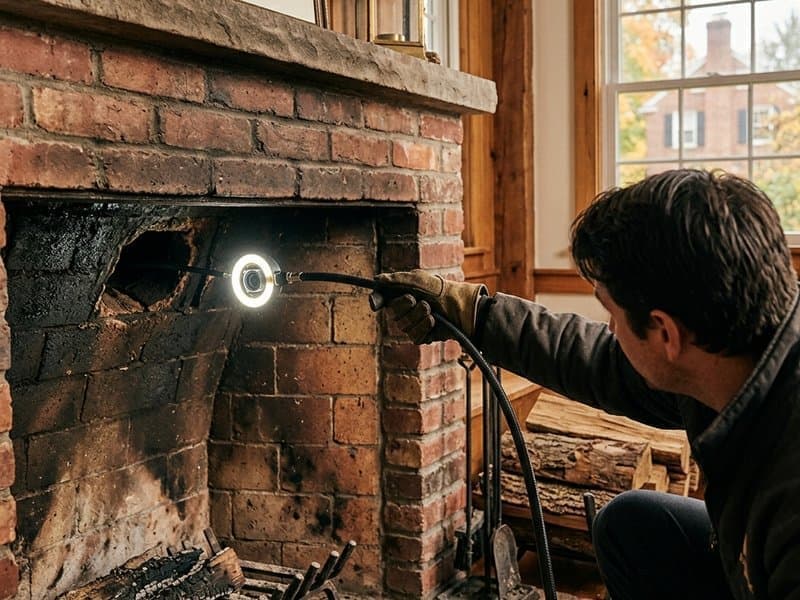
NFPA 211 inspection levels: Level 1 no camera, Level 2 video camera required. Each level includes all lower levels. Sweep durations, scope, scams to avoid.