Inspection Level Decider
Find out if you actually need a Level 2 inspection — or if a Level 1 is enough.

You just closed on a house with a fireplace. The previous owner left behind a wire mesh screen, a scuffed set of fireplace tools, and no documentation about when the chimney was last swept, what condition it's in, or whether the flue is even safe to use. You are now responsible for a piece of combustion equipment that vents hot gases through your roof. This guide is how you start, as a first-time fireplace owner, without getting hurt and without getting scammed.
The core message up front: do not light a fire in a fireplace you inherited until a qualified sweep has inspected it. That is the single most important rule for a new fireplace owner. Everything else — anatomy, maintenance schedules, costs, seasonal prep — follows from that starting point.
NFPA 211, the national fire code standard for chimneys, explicitly requires a Level 2 inspection any time a property transfers ownership. If you just bought the house, a Level 2 inspection is the standard-of-care baseline, not an upsell. It involves a professional video-camera scan of the entire flue interior, a thorough inspection of all accessible portions of the chimney, and a written report with dated photos or video documenting findings.
A Level 2 inspection typically costs $250 to $500 depending on metro. That is the right amount to spend before you ever strike a match. The inspection produces a written record of the chimney's condition the day you took over, which does several things for you at once: confirms the flue is safe to use, identifies any hidden damage (cracks in the liner, deterioration in the smoke chamber, flashing leaks), and establishes a legal baseline if you ever need to document the property's condition for insurance, a future sale, or a dispute with the prior owner.
If the home inspector who looked at the property during escrow told you "the chimney is fine" — that is not a Level 2 inspection. General home inspectors do a Level 1 visual check at best, often without removing the cap, and they do not run video cameras up the flue. A chimney "passing" a home inspection means only that nothing was obviously wrong from the outside. It does not mean the flue is safe for fires.
A fireplace and chimney system is a vertical stack of specific components, each doing a specific job. Learning the names is useful because it lets you follow what the sweep is doing, read invoices and reports accurately, and recognise when a "repair" being quoted doesn't apply to any part your chimney actually has.
Firebox. The chamber where the fire burns. Masonry fireboxes have refractory panels or firebrick on the walls and floor — cracked panels are a real repair, not a scam, but cracks smaller than a matchstick width generally aren't urgent.
Damper. A hinged metal plate that opens and closes the throat between the firebox and the flue. Closed when the fireplace isn't in use (stops heat loss), open when burning (lets smoke up the flue). Top-sealing dampers at the cap are a more modern alternative. A damper that won't open fully or is stuck is a common repair, typically $150-$400.
Smoke chamber. The tapered transition zone above the damper that funnels combustion gases into the flue. Parging — a smooth cementitious coating — is applied here in code-compliant installations. The smoke chamber is also the area where shortcut operators bill for a $2,000 parging job but actually apply a 1/8-inch Smoketite spray coating that does not meet NFPA 211 specs.
Flue. The vertical passage that carries combustion gases to the top of the chimney. In masonry chimneys, the flue is lined with clay tiles, stainless steel, or cast-in-place liner. In prefabricated (factory-built) chimneys, the flue is an insulated metal pipe. Flue condition is the single most important safety item.
Crown. The concrete or masonry slab at the top of the chimney that sheds water away from the flue opening. Cracks in the crown let water into the masonry below — "chimney crown repair" is a legitimate and common service, costing roughly $150-$600 for a sealant and $1,000-$3,500 for a rebuild.
Cap. The metal cover on top of the chimney that keeps rain, animals, and embers out. A missing cap is one of the most common issues in a newly purchased home. Replacement runs $200-$600 installed.
Flashing. Metal sheeting that seals the joint where the chimney meets the roof. Most chimney leaks are flashing failures, not chimney failures. Re-flashing costs $300-$1,500.
Knowing these parts means you can read an invoice and know what was serviced. An invoice that bills "chimney crown rebuild" on a chimney that doesn't have an accessible crown is fraud; an invoice that lists "flashing repair" on a chimney you just watched water leak into is legitimate.
The fuel type your fireplace burns determines what maintenance it needs, how often, and how scam-vulnerable you are. Scammers frequently bill gas-fireplace owners for annual wood-style sweeps that are not appropriate for gas systems.
Wood-burning fireplace. Burns solid cordwood. Produces the most creosote — a tar-like deposit from incomplete combustion that is the primary fuel in chimney fires. Requires annual inspection and sweeping when 1/8 inch of creosote has accumulated (heavy users need annual sweeps; occasional users every 2-3 years). Most scam-exposed fuel type because "creosote buildup" is the most commonly fabricated finding.
Gas fireplace. Burns natural gas or propane. Produces almost no creosote but does produce corrosive acidic condensation that can damage clay tile liners over time. Requires annual inspection (carbon monoxide risk is real — cracked heat exchangers or blocked flues can be fatal). Rarely requires sweeping in the traditional sense. Gas fireplaces with pilot lights also need seasonal service — pilot adjustment, thermocouple check, log replacement.
Pellet stove. Burns compressed wood pellets. Produces moderate ash that accumulates differently from wood creosote — finer, more uniform, less flammable but more voluminous. Requires annual venting-system cleaning and periodic internal cleaning of the stove's heat exchanger. Pellet vents are smaller diameter than wood chimneys and clog faster if sweeps are delayed.
If you don't know what fuel type you inherited, look inside the firebox. Ceramic logs with a gas line visible at the back = gas. Actual firebricks, no gas line, andirons or a grate = wood-burning. A freestanding metal appliance with a hopper on top = pellet stove. A freestanding metal appliance without a hopper, vented through a metal pipe = wood stove.
Every fireplace, regardless of fuel type, follows a roughly similar annual rhythm. Learning the cycle once means you do not need a sweep to tell you what to do — you can schedule service proactively and evaluate quotes against a baseline you already understand.
Pre-season (August through October). This is when you schedule your annual inspection and sweep if one is needed. Demand is highest in August-November so book early — waiting until November means you may be scheduling into December or January. Pre-season is also the right time for cap installation, flashing repair, and any identified crown work, while the weather is still warm enough for masonry and sealant to cure properly.
Burning season (November through March). Daily or weekly fires if you use the fireplace heavily. Keep an eye on the cap for animal nesting, the damper for smooth operation, and the firebox for any refractory panel damage from hot fires. Store only seasoned hardwood — wood dried to below 20% moisture content. Green or wet wood burns cold, produces two to three times more creosote, and is the fastest way to accelerate unnecessary sweep frequency.
Post-season (April through May). Good time to check the exterior of the chimney. Water damage from winter shows up here: cracks in the crown, flashing failures visible as interior ceiling stains, mortar joint damage from freeze-thaw cycles. If you're going to do exterior masonry repairs, spring is ideal because the masonry needs to cure before next winter.
Off-season (June through August). Sweep appointments are easiest to book, prices are sometimes lower, and operators are less rushed. If you know you'll need service, off-season scheduling gets you better attention. This is also the window for "whole-system" planned work — major repairs, relining, or rebuilds that take multiple days.
First-time owners are the highest-value targets for chimney sweep scammers. You have no local network, no referrals, no previous sweep relationship, and no baseline for what normal pricing looks like. Scammers know this. A first-time homeowner is why the $1,400-for-18-minutes scam exists.
Your three best sources, in order of reliability: a direct referral from a neighbour who has lived in the area for 5+ years, a CSIA directory search for your ZIP code, and a directory like FindChimneySweepers that pre-filters for verification. Avoid Angi, Thumbtack, and similar lead-gen platforms as a first resort — those platforms sell your contact information to the highest-bidding operator in your ZIP, which is precisely the operator least likely to be competing on quality.
Before you book, do three things. First, Google the business name and the word "scam" or "complaint" — any pattern of complaints will surface in the first page. Second, verify the business address exists on Google Maps (not a UPS Store, not a PO box, not a residential address with no business presence). Third, check that the phone area code matches the state — a Miami area code on a supposed Seattle chimney sweep is a multi-alias operation flag.
On the phone, ask five questions before booking:
A legitimate sweep answers all five without hedging. A scammer objects to the questions, refuses to provide documentation, or gives vague answers about pricing.
The first chimney sweep who visits your new home is setting expectations you will use for years. Use the first visit as a calibration.
The tech should arrive in a branded vehicle — company name, phone number, and usually a CSIA logo visible. They should introduce themselves, identify their certification, and walk you through what they will do before starting. For a standard sweep, expect them to lay drop cloths around the firebox, set up a containment system (often a plastic sheet with a vacuum hose to trap soot), and then access the flue from both the rooftop and the firebox.
Expect 45 to 90 minutes on site. Expect photos of the flue interior, before and after. Expect them to show you what came out of the flue — a real sweep produces a visible amount of creosote and soot, and a confident operator will show you the pile. Expect a written report summarising the flue condition, any findings, any recommended repairs (with a clear separation between "essential" and "recommended"), and a clearly itemised invoice.
If your first sweep tells you "everything looks fine, you don't actually need a cleaning this year" — that is the strongest trust signal in the entire VoC research. The consumer reaction to an operator who says "I don't need to charge you, your chimney is clean" is near-universal loyalty. That operator just earned a customer for life. Pay for the inspection ($150-$300), and remember the name.
First-time owners consistently make the same handful of mistakes. Each one either damages the chimney directly, accelerates creosote buildup, or opens the door to scam pressure. None of them are irrecoverable if you catch them early.
Burning unseasoned or treated wood. Green wood with moisture above 20% burns cold, produces two to three times more creosote, and drastically accelerates flue buildup. Treated lumber, painted wood, or construction scraps release toxic compounds and also coat the flue with non-standard residues that complicate sweeping. Burn only seasoned hardwood, ideally split for 6-12 months and stored under cover.
Closing the damper too early. After a fire, the firebox and flue are still hot and off-gassing. Closing the damper while the fire is hot traps combustion byproducts in the house and can force carbon monoxide back into the living space. Wait until the fire is out, the coals are cold to the touch, and there is no visible smoke.
Ignoring or skipping the cap. A missing cap lets rain, animals, and debris into the flue. Water mixed with creosote forms a mild acid that attacks the liner. Birds and squirrels build nests that block draft. Installing a cap on a missing-cap chimney is one of the best $400 upgrades you can make in year one.
Skipping the first-year Level 2 inspection. Described above, but worth repeating — this is the single most common mistake and the single most expensive to undo.
Accepting the first quote on any five-figure repair finding. If the first sweep tells you the chimney needs $8,000 of work, do not sign the contract that day. Get two more quotes. The VoC research has documented cases where five quotes for the same chimney ranged from $700 to $20,000, with three of the five reporting "good condition, $2,000 for minor maintenance."
Budget for year one is higher than subsequent years because of the Level 2 inspection and any baseline repairs that the inherited chimney may need. A reasonable first-year budget for a wood-burning fireplace owner looks like:
| Item | Low | High |
|---|---|---|
| Level 2 move-in inspection | $250 | $500 |
| Standard sweep if needed | $175 | $350 |
| Cap installation (if missing) | $200 | $600 |
| Crown sealant (if cracks present) | $150 | $400 |
| Minor flashing touch-up | $0 | $500 |
| Total year one | $575 | $2,350 |
Subsequent years, assuming the chimney was sound at move-in, typically run $150-$400 for annual inspection and (if needed) sweep. Year one is the expensive year precisely because you are doing the investigative work that should have been done at the property inspection stage and wasn't.
Note the low end of this range is well under $600 for a complete first-year fireplace inheritance. If your first sweep hands you a quote for $5,000-$20,000 on a chimney that isn't visibly damaged from the outside, get a second opinion before approving — large quotes on an undamaged exterior often reflect a very different scope than what other operators would recommend.
| Maintenance Item | Wood-Burning | Gas Fireplace | Pellet Stove |
|---|---|---|---|
| Annual inspection | Required | Required | Required |
| Annual sweep | Recommended if used heavily | Rarely needed | Required |
| Creosote concern | High | Minimal | Moderate (ash) |
| CO detector required | Yes | Yes (critical) | Yes |
| Damper service | Every 3-5 years | N/A | N/A |
| Cap inspection | Annually | Annually | Annually |
| Typical annual cost | $175-$350 | $150-$250 | $200-$350 |
Use this as a reminder for year one. By year two, the cycle becomes automatic.
Browse 30+ guides, or jump straight to verified operators in your state.
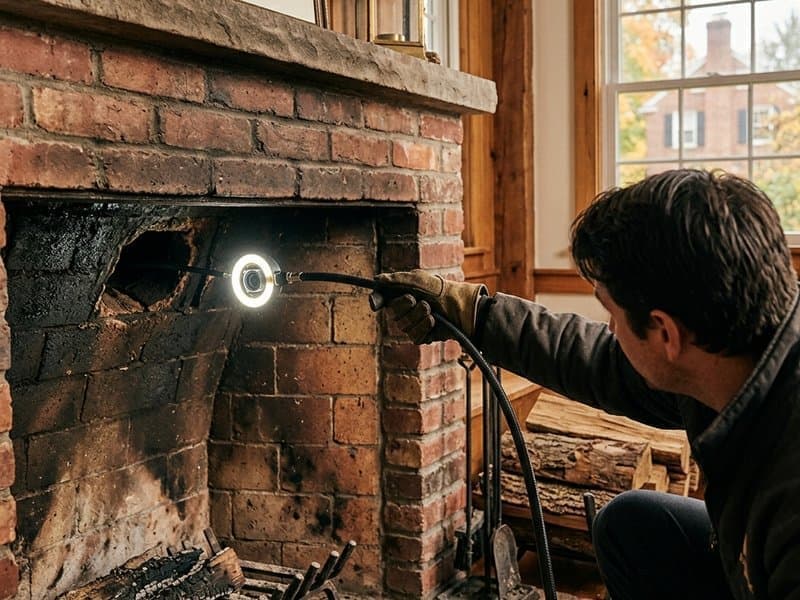
NFPA 211 inspection levels: Level 1 no camera, Level 2 video camera required. Each level includes all lower levels. Sweep durations, scope, scams to avoid.
The 10 trust signals that separate honest chimney sweeps from scammers. Vetting questions, verification steps, and how to avoid paying 10x market rate.
How often should you clean your chimney? The direct answer from NFPA 211, broken down by fuel type and usage — plus when annual sweeps are a scam.
Find out if you actually need a Level 2 inspection — or if a Level 1 is enough.
See what verified chimney sweeps charge in your area for each service.
Personalised sweep/inspection calendar — reminders before peak season.