
Cost Estimator
See what verified chimney sweeps charge in your area for each service.
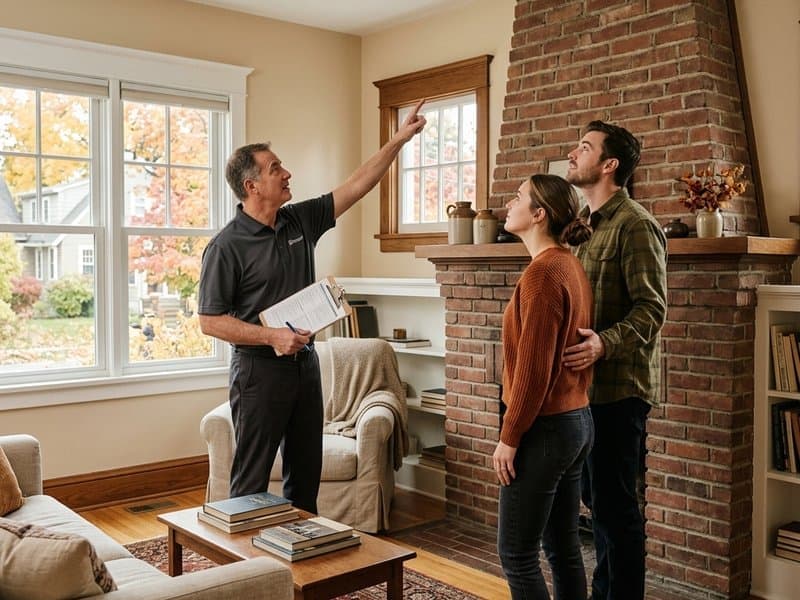
You are about to sign paperwork on a $350,000 house with a fireplace, and the general home inspection report says "fireplace: functional." That single word is doing a staggering amount of work, and it is almost certainly wrong. A general home inspector does not have the tools, the certification, or the time to actually evaluate a chimney. What they did was light a match, confirm the damper opens, look up into the firebox with a flashlight, and check a box. Whatever problems exist in the 25 feet of flue above that firebox — cracked liners, failed crown, missing cap, compromised clearance to combustibles, active leaks — are now yours the moment you close.
This guide is how you prevent that. The rule is simple: before closing on any house with a fireplace, chimney, or wood stove, order a separate Level 2 chimney inspection. It costs $250 to $500. It will find things that cost thousands to fix. And those findings are the single most effective negotiation tool you have before the inspection contingency expires.
This is not a FindChimneySweepers recommendation. It's a published industry standard. NFPA 211 — the National Fire Protection Association standard that governs chimney inspection in the United States — explicitly requires a Level 2 inspection whenever a property changes hands. The standard is titled "Standard for Chimneys, Fireplaces, Vents, and Solid Fuel-Burning Appliances." Section 14.3 covers inspection levels, and the triggering conditions for a mandatory Level 2 include property transfer, changes to the appliance connected to the flue, and events that may have damaged the chimney.
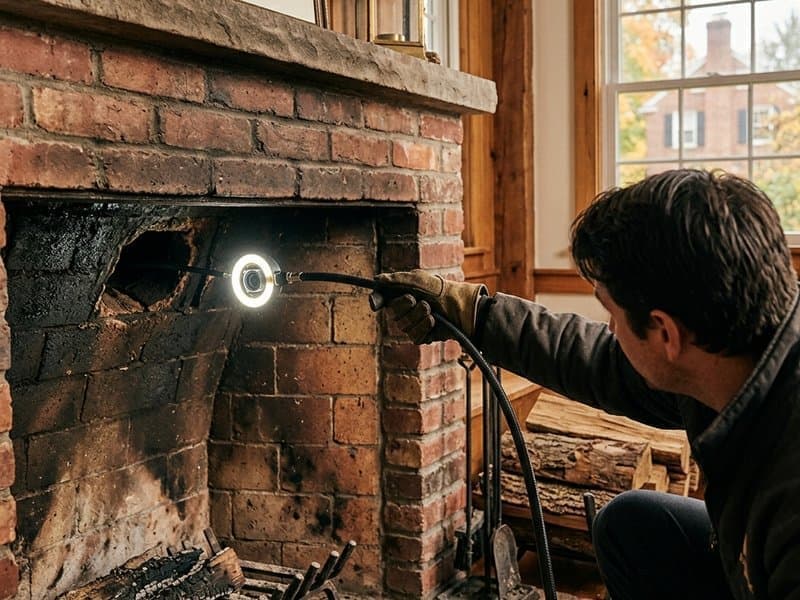
A Level 1 inspection — the visual-only check a general home inspector might perform — is explicitly insufficient for a property transfer. The standard requires the additional scope of a Level 2: camera inspection of the full flue interior, inspection of accessible concealed spaces (attic, crawlspace) for clearance to combustibles, and verification that the appliance matches the flue.
You can close on the house without this inspection. Lenders don't require it. Your real estate agent may not mention it. Your home inspector may not even know the requirement exists. The standard is the standard regardless — and if the house ever has a chimney fire traced to a pre-existing defect that a Level 2 would have caught, your insurance carrier may cite the missed inspection in denying coverage.
General home inspectors are generalists. That's not an insult — it's a description of the job. They inspect roofs, electrical, plumbing, HVAC, foundation, attic, crawlspace, appliances, windows, and dozens of other systems in three hours. They have neither the time nor the specialised equipment to evaluate a chimney the way a CSIA-certified chimney inspector can.
What a general home inspector typically does for the chimney: looks at the exterior from the ground (sometimes from the roof if they're comfortable going up), opens the firebox damper, shines a flashlight up the flue, checks that the damper moves, confirms the firebox refractory isn't visibly crumbling. That's a Level 1 at best — often not even that, because many home inspectors skip the rooftop work entirely.
What a general home inspector does not do: run a video-scan camera up the flue to check liner condition, check attic framing for clearance to combustibles, pull appliance specs and verify they match the flue size and type, or produce a written chimney-specific report with photos and findings. Those are the things a Level 2 inspection exists to cover, and they cannot be done in the time budget of a general home inspection.
"Fireplace functional" on a home inspection report means the damper opens and the firebox visible portion is not obviously catastrophic. It does not mean the liner is intact. It does not mean the crown is sound. It does not mean the flashing isn't leaking. It does not mean the clearances to combustibles meet code. Treat "fireplace functional" as equivalent to "we didn't see anything on fire" — useful but far from a clean bill of health.
A proper Level 2 inspection performed by a CSIA-certified chimney inspector takes 60 to 90 minutes and covers specific items that a home inspection cannot.
Camera inspection of the full flue interior. The inspector runs a Chim-Scan or equivalent video camera up the entire length of the flue from top to bottom. This identifies cracked or spalled clay tiles, gaps or separations between tiles, deteriorated metal liners, creosote stage-three glazing, and obstructions (bird nests, broken tile fragments, debris). The inspector should provide video footage or still images from the camera run as part of the report.
Accessible concealed space inspection. The inspector checks attic and (where accessible) crawlspace sections of the chimney for clearance to combustibles per code. This is where invisible problems live: wood framing pressed against masonry that should have a two-inch air gap, insulation touching the flue, or historic alterations that left combustible materials in contact with the chimney. A chimney fire is an event every homeowner fears; a clearance-to-combustibles violation is the pre-conditions for that event.
Exterior condition assessment. Crown condition (cracked, deteriorated, missing), cap presence and condition, flashing integrity where the chimney meets the roof, masonry condition above the roofline (spalling, step cracks, mortar failure), and overall structural plumb.
Appliance-flue match verification. If the fireplace has been converted to gas, or if a wood stove has been installed and vented into the masonry chimney, the inspector verifies the flue size, type, and configuration is appropriate for the appliance. A mismatch — wood stove vented into an oversized fireplace flue, gas insert vented without a proper liner — is a fire or carbon monoxide hazard.
Written report with photos. A Level 2 inspection produces a dated written document listing findings, each with photo or video evidence, severity rating, and recommended action. This is the document you hand to your real estate agent for negotiation. "Verbal report" is not acceptable on a pre-purchase inspection — ask for the written report in advance of scheduling.
A Level 2 chimney inspection runs $250 to $500 in most US metros, with coastal cities and high-cost-of-living areas reaching $600. Against a $300,000+ house purchase, this is rounding error — less than one-tenth of one percent of the purchase price, and a fraction of your closing costs.
Some inspectors offer pre-purchase inspections as a flat rate; others charge by chimney (a home with both a main fireplace and a secondary wood stove chimney costs more). A few charge extra for the written report, which is the core deliverable — clarify the report is included before booking.
Payment is usually due at time of service, by check or card directly to the inspector. The inspection cost is part of your inspection-period out-of-pocket budget; it is not rolled into closing costs in most cases.
Pre-purchase Level 2 inspections commonly surface a predictable set of findings. Use this table to estimate the repair cost and the negotiation leverage each finding creates.
| Finding | Severity | Typical Repair Cost | Negotiation Leverage |
|---|---|---|---|
| Missing chimney cap | Low | $200-$600 | Ask seller to install before close |
| Cracked crown (hairline) | Moderate | $300-$800 (sealing) or $500-$2,000 (rebuild) | Credit at close or seller remediation |
| Failed crown (major cracks) | Moderate-High | $1,000-$3,000 | Credit or seller remediation required |
| Failed flashing | Moderate | $400-$1,500 | Credit at close |
| Deteriorated liner (minor cracks) | Moderate-High | $1,500-$3,500 | Significant credit or remediation |
| No liner on masonry chimney | High | $2,500-$5,000 | Must be resolved before use |
| Spalling masonry (localised) | Moderate | $500-$2,500 | Credit at close |
| Spalling masonry (widespread) | High | $2,500-$8,000 | Major credit or remediation required |
| Clearance to combustibles violation | High | $1,500-$5,000 | Must be resolved before use |
| Chimney tilted or leaning | Critical | $8,000-$20,000+ (partial or full rebuild) | Potential deal-breaker; specialist assessment |
| Structural separation from house | Critical | $10,000-$25,000+ | Potential deal-breaker |
"Negotiation leverage" in this table assumes you received the inspection report before the inspection contingency expired. If the contingency is already closed, you have no leverage — you just own the problem.
The mechanics vary by state and by contract, but the pattern is consistent nationwide. Your chimney inspection report becomes an addendum to your negotiation with the seller, requesting one of three outcomes.
Seller remediation before close. The seller hires a contractor to perform the repair, provides proof of completion, and closing proceeds on the original timeline. This works best for critical findings — no liner, clearance violations, structural issues — where you genuinely need the problem fixed before the house is safe to use. The risk: sellers often hire the cheapest available contractor with the shortest timeline, and the quality of the remediation may not match what you would have done yourself.
Credit at close. The seller credits you a specific dollar amount against the closing costs or purchase price, and you handle the repair after you own the home. This works best for moderate findings — flashing, cap, crown sealing, minor masonry — where you want to choose your own contractor and oversee the work. Standard practice is to credit at the upper end of the estimated repair range to account for contractor variability.
Price reduction. For large findings (structural issues, widespread spalling, full rebuild), the seller reduces the purchase price by the repair cost. This works best when the repair is large enough that a credit at close would push closing costs above what lenders will allow.
Getting the numbers right. Attach the written Level 2 inspection report to the negotiation addendum. Include specific repair estimates — ideally from two licensed contractors — so the negotiation isn't abstract. "The inspector flagged a deteriorated liner, here are two repair quotes at $3,200 and $3,800, we request a $3,500 credit at close" is a negotiation the seller can evaluate. "Something is wrong with the chimney, we want money" is not.
Your real estate agent does this. A competent agent has handled chimney findings dozens of times and knows the local norms for how sellers respond. Let your agent present the addendum — they know whether this specific seller is likely to remediate, credit, or push back.
Schedule the chimney inspection during the general inspection period, which is typically 7 to 14 days after the accepted offer. Don't wait until the last day — you need time for the inspector to complete the work, write the report, and send it to you, plus time for you to review findings with your agent and draft a negotiation addendum before the inspection contingency expires.
Recommended timeline:
If the seller drags their feet responding to the addendum, your agent can request an extension of the inspection contingency. Don't let the contingency expire while negotiation is still active.
Some sellers provide a pre-listing chimney inspection report, often dated within the last 12 months, showing a clean or acceptable condition. Do not rely on this. Get your own.
The reasons are obvious once you think about them. A seller-provided report is paid for by the seller. The inspector who wrote it has an ongoing business relationship with the seller or the seller's agent. The scope of the inspection may have been limited — a Level 1 instead of a Level 2, for example. The findings may have been documented but omitted from the summary. And any deterioration that occurred after the inspection date isn't in the report at all.
Spending $300-$500 on your own independent inspection to verify a six-figure purchase is trivially cheap insurance. An independent inspector working for you has incentive only to document what they actually see — they're not protecting a future referral stream from the listing agent.
Certain listing language correlates with undisclosed chimney problems. None of these is dispositive, but each should trigger extra scrutiny during the inspection.
"Fireplace is decorative only" / "fireplace not operational". This sometimes means the seller wants to avoid fireplace-related disclosure paperwork. More often, it means there's a known problem — liner failure, crown collapse, unresolved flashing leak — that the seller doesn't want to fix and doesn't want to disclose. The problem becomes yours after closing regardless of how the fireplace is advertised. Inspect it anyway.
"Fireplace — as is" / "chimney serviced [date]" without a recent sweep. The specific claim of service is often offered to defuse buyer questions without actually demonstrating condition. A sweep from five years ago tells you nothing about today.
No fireplace disclosure in the seller's disclosure statement when a chimney is visible from the exterior. Missing disclosure isn't proof of a problem but is grounds to ask direct questions in writing.
New masonry or fresh flashing visible on the chimney in listing photos. Recent work sometimes reflects ordinary maintenance and sometimes reflects a rushed pre-listing repair of a known issue. Ask what was done, by whom, and request the invoice or warranty.
The first time you use the fireplace in your newly purchased home is the moment at which hidden chimney defects become visible as smoke, carbon monoxide, or fire. Do not light a fire in a newly purchased home without a Level 2 inspection on record. This applies even if the seller tells you the fireplace "works fine."
Works fine for the seller — who may have been using a compromised chimney for years without incident — is not the same as works safely. A Level 2 tells you whether the flue is intact, the clearances are compliant, and the appliance matches. Without it, you're gambling that the house's previous luck transfers to you.
If you close without a pre-purchase Level 2 (a bad idea, but it happens), do not use the fireplace until you've had a Level 2 performed post-close. Cost is the same $250-$500. Safety margin is infinitely better than "probably fine."
Browse 30+ guides, or jump straight to verified operators in your state.
NFPA 211 inspection levels: Level 1 no camera, Level 2 video camera required. Each level includes all lower levels. Sweep durations, scope, scams to avoid.
The 10 trust signals that separate honest chimney sweeps from scammers. Vetting questions, verification steps, and how to avoid paying 10x market rate.

Just bought a house with a fireplace? The complete first-time owner guide — inspections, maintenance, costs, and how to avoid scams in year one.