Inspection Level Decider
Find out if you actually need a Level 2 inspection — or if a Level 1 is enough.
NFPA 211 is the national US fire safety standard for chimneys, fireplaces, vents, and solid-fuel-burning appliances. It is published by the National Fire Protection Association and updated roughly every three years. Every legitimate chimney professional references it. Most homeowners have never heard of it.
The information gap matters because NFPA 211 is the document every chimney sweep recommendation should trace back to. When a sweep tells you the chimney "needs" a Level 2 inspection, or "requires" a new liner, or "must" have a specific clearance from combustibles — those claims either come from NFPA 211 (or a local code that references it) or they are being made up. A homeowner who knows the standard exists, and can ask "which section of NFPA 211 requires this?", shifts the conversation from trust-based to evidence-based immediately.
NFPA 211 is formally titled Standard for Chimneys, Fireplaces, Vents, and Solid Fuel-Burning Appliances. It is published by the National Fire Protection Association, a non-profit based in Quincy, Massachusetts, founded in 1896. NFPA is the same organisation that publishes NFPA 70 (the National Electrical Code), NFPA 13 (sprinkler systems), and NFPA 72 (fire alarm systems). It is the primary body for US fire-safety standards and has been for over a century.
NFPA 211 itself covers four broad areas:
The standard is a technical document of several hundred pages with numbered chapters, sections, and subsections. Homeowners do not need to read it. You need to know it exists and what it governs, so that when a sweep references it (or invents things it supposedly says), you have a frame of reference.
Three reasons the standard is directly relevant to you.
First, NFPA 211 defines the three chimney inspection levels. Every time a sweep mentions "Level 1", "Level 2", or "Level 3", they are referencing NFPA 211 definitions. The details are covered in inspection-levels, but the short version is: Level 1 is annual visual inspection (standard), Level 2 is required at property transfer or after events like chimney fires (includes camera scan), Level 3 is invasive inspection when concealed damage is suspected (rarely needed). An operator claiming a Level 2 is required on a healthy chimney with no triggering event is misrepresenting the standard.
Second, NFPA 211 sets the 1/8-inch creosote threshold for sweeping. The standard does not require annual sweeping. It requires sweeping when accumulation reaches 1/8 inch or more, when glaze is present, or when obstructions are identified. Operators who bill for annual sweeps regardless of actual buildup are either inefficiently sweeping under the threshold or padding revenue. Either way, knowing the threshold lets you ask: "What did the inspection measure as the current creosote depth?"
Third, NFPA 211 is adopted by reference in most state and local fire codes. While the standard itself has no statutory authority — NFPA is a private organisation, not a government agency — most jurisdictions incorporate NFPA 211 into their local building and fire codes. Your fire marshal enforces it as part of local code. That makes the standard effectively law in most of the US, even though it is not technically federal law.
Six specific provisions are worth knowing by name.
Section 14.3.1 specifies annual inspection for chimneys in regular use. The inspection can be Level 1 (visual check of readily accessible portions) for normal use with no change in fuel type or appliance. This is the basis of the industry's "get your chimney inspected every year" recommendation.
Chapter 14 defines three inspection levels. Level 1 is routine annual. Level 2 is mandatory at property transfer, after chimney fires, after earthquakes or other impact events, and when changing fuel types or appliances. Level 3 is invasive and reserved for situations where Level 2 findings indicate damage in concealed portions of the chimney.
Section 14.2.1 specifies sweeping when 1/8 inch of soot or creosote has accumulated, when glaze is present, or when obstructions are present. The standard explicitly does not mandate calendar-based sweeping.
Chapter 12 specifies minimum distances between chimney exterior and combustible wall or roof materials — typically 2 inches for masonry chimneys, 1 inch or more for factory-built chimneys depending on listing. This is why inspectors check what's inside walls around chimneys and why this dimension matters.
Section 12.6 specifies that chimney termination should extend at least 3 feet above the roof penetration point and at least 2 feet above any structure within 10 feet of the chimney. This is the "3-2-10 rule" that determines proper chimney height. Chimneys that are too short suffer poor draft and may be required to be extended.
Chapter 7 specifies that chimneys must have a listed flue liner suitable for the connected appliance. Masonry chimneys typically use clay tile, stainless steel, or cast-in-place liners. Gas appliance chimneys require liners compatible with acidic condensation.
NFPA 211 is a standard published by a private non-profit. On its own, it has no statutory force. A chimney that fails NFPA 211 requirements is not automatically illegal.
However: most US state fire codes and building codes adopt NFPA 211 by reference. The International Fire Code (IFC) and International Residential Code (IRC) — the base codes that most states customise for their own use — incorporate NFPA 211 for chimney-related sections. Once a local jurisdiction adopts the IFC, IRC, or state-specific fire code, NFPA 211 becomes enforceable as part of that code.
In practice, this means:
The standard is functionally enforceable even though the NFPA itself has no enforcement authority. Your jurisdiction likely has adopted some version of it.
Citing NFPA 211 is itself a trust signal — a legitimate operator references it accurately. Citing it incorrectly is a red flag. The VoC research documents several specific patterns of scammer misrepresentation.
"NFPA 211 requires a Level 2 inspection." Almost never true in a routine annual service context. Level 1 is the standard for annual inspection. Level 2 is triggered by specific events: property transfer, chimney fire, earthquake or impact, change in fuel type, change in appliance. A sweep claiming Level 2 is "required" for a homeowner who has lived in the house for years without any triggering event is misrepresenting the standard.
"NFPA says your chimney is condemned." NFPA 211 does not condemn chimneys. The standard describes construction, inspection, and maintenance requirements. Condemnation — the official determination that a structure is unsafe for use — is done by a local fire official or building inspector, not by a chimney sweep and not by NFPA itself. An operator who tells you "NFPA says you can't use this chimney" is conflating their own opinion with the authority of the standard.
"Deep clean is required under NFPA 211." "Deep clean" appears nowhere in NFPA 211. Section 14 describes sweeping as removal of accumulated creosote and soot. "Deep clean" is a fabricated service category invented for upsell purposes. Any operator citing NFPA 211 as justification for a deep clean is misrepresenting the standard.
"NFPA 211 requires annual sweep." The standard requires annual inspection. Sweeping is required only when creosote accumulation hits the 1/8-inch threshold. An operator who claims annual sweeping is mandatory under NFPA 211 is misrepresenting the actual standard, which is condition-based, not calendar-based.
"NFPA 211 latest edition says..." Editions vary. The 2024 edition differs from the 2019 edition in several sections. Most jurisdictions adopt a specific older edition rather than the newest. An operator citing "the latest NFPA 211" without specifying edition or without clarifying which edition your jurisdiction has adopted is relying on your inability to verify the claim.
| Topic | What NFPA 211 Actually Says | What Scammers Often Claim |
|---|---|---|
| Annual service | Annual inspection required; sweep only when 1/8" creosote present | "Annual sweep required" |
| Level 2 inspection | Required at property transfer, after fire, after impact events | "Required every year" or "required on any inspection" |
| "Deep clean" | Not mentioned anywhere | "Deep clean is NFPA-required" |
| Condemnation | Done by local fire/building officials only | "NFPA says your chimney is condemned" |
| Liner requirements | Chimney must have a listed, appliance-compatible liner | "NFPA requires a new stainless steel liner every X years" |
| Height requirements | 3-2-10 rule specifies minimum height | Fabricated additional height "requirements" |
These three terms get conflated. Understanding the relationship helps you read inspection reports and quotes accurately.
NFPA 211 is a voluntary private standard that sets best-practice technical requirements.
Building codes are enforceable local laws that govern how structures are built and modified. Most US jurisdictions adopt some version of the International Residential Code (IRC) or International Building Code (IBC), which reference NFPA 211 for chimney-related provisions.
Fire codes are enforceable local laws that govern fire-safety practices and are typically based on the International Fire Code (IFC) or NFPA 1 (NFPA's own fire code). Both reference NFPA 211 for chimney-related provisions.
In practice: if your chimney is non-compliant with NFPA 211, it's probably also non-compliant with your local building and fire codes. A permit application for chimney work will be reviewed against local code (which incorporates NFPA 211). An insurance claim for chimney fire damage will be evaluated partly against NFPA 211 compliance as documented in inspection reports.
You do not need to read the full standard. You need two practical skills.
Ask which section applies. When a sweep recommends expensive work, ask: "Which section of NFPA 211 requires this?" A legitimate operator can cite a chapter and section number for safety-critical work — for example, "Chapter 12 clearance-to-combustibles for the 2-inch requirement," or "Section 14.2 for the sweep threshold." A scammer will hedge, change the subject, or get visibly uncomfortable. The evasion is the information.
Request NFPA 211 section citations on written reports. A Level 2 inspection report should reference specific NFPA 211 sections for each finding. "Flue tile cracking observed; does not meet NFPA 211 Chapter 7 liner integrity requirements" is a well-formed finding. "Chimney needs work" is not. If the report contains only vague findings without code references, the inspection was either sloppy or the findings are fabricated.
Check the edition. Your local jurisdiction adopts a specific edition of NFPA 211 — typically one to two editions behind the current. Your city's building department website usually documents the adopted edition. A sweep citing requirements from a newer edition than your jurisdiction has adopted is citing requirements that do not apply to you.
Browse 30+ guides, or jump straight to verified operators in your state.
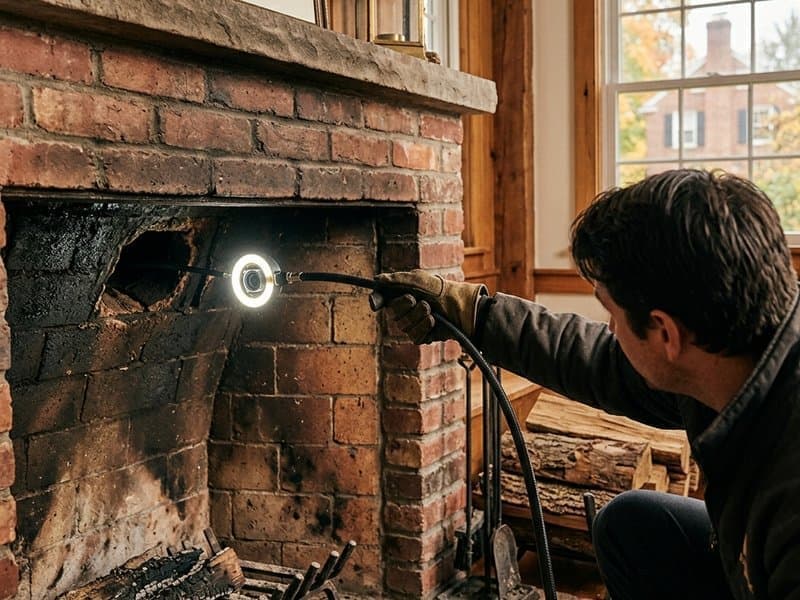
NFPA 211 inspection levels: Level 1 no camera, Level 2 video camera required. Each level includes all lower levels. Sweep durations, scope, scams to avoid.
The 7 chimney sweep scam patterns — bait-and-switch deep clean upsell vs legitimate chemical treatment, fake Level 2, multi-alias SEO, unnecessary relining.
The 10 trust signals that separate honest chimney sweeps from scammers. Vetting questions, verification steps, and how to avoid paying 10x market rate.