Is My Quote a Scam?
Instant sanity check on any quote against verified pricing for your zip.
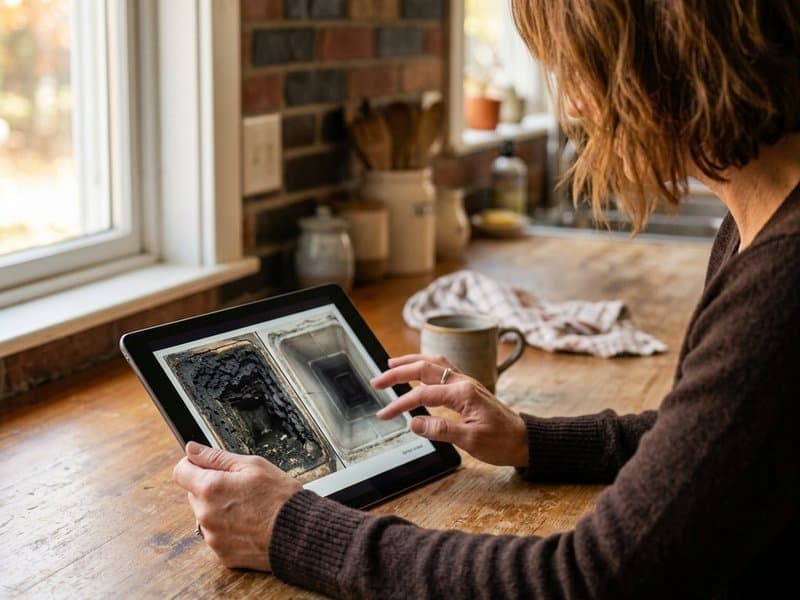
You cannot see inside your own chimney. That single fact is the root of every chimney sweep scam documented in the last decade. A dishonest technician can show up, stay 18 minutes, hand you an invoice for $988, and drive away — and unless you know what verification actually looks like, you will pay it.
This guide is the counter-move. It tells you exactly how to tell if your chimney sweep did the work they billed you for, what the timeline and evidence should look like, and what to do if you suspect the job wasn't actually performed. The goal isn't paranoia — it's competence. A real sweep expects you to verify the work. A fake one counts on you not knowing how.
Most home services leave visible evidence. A painted wall is painted. A new water heater is a new water heater. Chimney work is different: the flue is a dark vertical tunnel extending 20 to 40 feet above your firebox, most of it invisible without a $3,000 video-scanning camera system. A homeowner with a flashlight can see the bottom few feet. Everything else is a black hole.
That information asymmetry is why the scam patterns documented on FindChimneySweepers.com — the 18-minute billed-as-two-hour sweep, the liner paid for but never installed, the $2,000 parging job substituted with 1/8-inch spray coating — work. The homeowner has no way to check. The invoice says the work was done, and short of hiring a second sweep with a camera, there is no physical evidence to contradict it.
Verification reverses this dynamic. The moment you start documenting the visit, asking for photos, and tracking timing, you move the burden of proof back onto the operator. Honest operators welcome this. Dishonest ones resist it. That resistance is itself one of the strongest signals you can read.
The best verification happens before the sweep arrives. You want a photographic baseline of the firebox, damper, and exterior chimney so that any "problem" the technician later "discovers" can be cross-checked.
Spend 10 minutes with your phone the morning of the appointment. Photograph the firebox floor (soot level, debris, any cracks in the refractory panels). Photograph the damper in the open position if it will open — note whether it moves freely. Step back and photograph the chimney exterior from two angles — the crown, the flashing where it meets the roof, and the cap if visible from the ground. If you have a bright flashlight, shine it up the flue from inside the firebox and take a photo or short video of what's visible.
This baseline costs you nothing and gives you two specific defences. First, if the technician later claims the firebox refractory "is cracked and needs replacement," you can check whether the crack existed before they arrived or appeared mysteriously during their visit. Second, if you later need to file a small-claims dispute, photo evidence of pre-service condition is powerful. Screenshot the advertised price for the service as well — a flyer, Google ad, or website price that later turns into a $1,400 quote is a documented bait-and-switch pattern and you want the original number in writing.
A legitimate standard chimney sweep takes 45 to 90 minutes for a single flue, not counting drive time. That range is narrow for a reason. The sweep has to access the flue from both the rooftop and the firebox, run rods and brushes top-down or bottom-up, vacuum the debris, inspect the liner and smoke chamber, and generate a written report. None of that happens in 20 minutes.
If the technician is in and out in under 30 minutes for a full sweep billed at a standard price, something is wrong. Either they are not doing the rooftop work (one of the most commonly skipped steps, particularly on steep or tall roofs), or they are cleaning only the visible lower section of the flue and leaving the upper sections coated. Creosote is thickest near the cap because flue gases cool as they approach the top — the section most likely to be skipped is the section most likely to catch fire.
Write down the technician's arrival and departure times. If the invoice bills for two hours of work and the tech was at your house for 35 minutes, you have a documented billing discrepancy in your own notes. That matters for disputes.
A real sweep accesses the chimney from the rooftop (cap removed or lifted, rods extended down the flue) and from inside the firebox (damper opened or removed, brush pushed up from below). Cleaning from only one direction leaves half the flue effectively untouched.
You do not need to climb a ladder to verify this. Ask the technician directly at the start of the visit: "Will you be working from the roof as well as from the firebox?" Then watch. Did they actually go up to the roof? Did a ladder come off the truck? Was there a tarp or drop cloth around the cap area on the roof during the work? If the answer to any of these is no on a job billed as a full sweep, the work wasn't complete.
Some operators will claim "we use a dual-access system from the bottom that makes rooftop work unnecessary." This is not a standard industry practice. It is a rationalisation for skipping the hardest part of the job.
A legitimate chimney sweep produces physical evidence of the work — both before and after. Ask for it explicitly.
Before the sweep starts, a camera scan or at minimum a clear photograph of the flue interior establishes the starting condition. For Level 2 and Level 3 inspections, camera footage is non-negotiable under NFPA 211 standards — a video-scan is the entire defining feature of a Level 2 inspection. If the tech claims to be doing a Level 2 without a Chim-Scan or equivalent professional camera, they are not actually doing a Level 2, regardless of what the invoice says.
After the sweep, a real operator will show you the debris they removed. This isn't ceremony — it's the physical evidence of the job. A single flue with 1/8 inch of creosote buildup, when removed, produces a visible pile of dark flaky material. If the technician vacuums everything straight into a sealed hopper on the truck without showing you the before-and-after debris comparison, you have no evidence anything was actually removed.
Request before-and-after photos of the flue interior. Honest sweeps often provide these unprompted as part of a written report. If the operator resists, pushes back, or claims photos "aren't part of our service," you should treat that as a significant red flag.
Walk through this list before you pay the invoice. Every "no" is a flag worth investigating further.
Did they take before-and-after photos and share them with you? A real sweep expects to document the work. Absence of photos is not neutral — it's a deliberate choice to leave no evidence.
How long were they on site? A Level 1 inspection plus sweep typically runs 45-60 minutes (sweeping itself is 15-30 minutes; Level 1 adds ~30 minutes). A Level 2 plus sweep typically runs 1.5-2 hours. Under 30 minutes for a Level 1 + sweep, or under 1 hour for a Level 2 + sweep, is a major flag. Document arrival and departure times in your own notes, not the invoice.
Did they access the flue from both the rooftop and the firebox? Note: rooftop access is not within the scope of a Level 1 inspection (it can require OSHA-compliant fall protection), so a Level 1-only visit may not include rooftop work. For a sweep, however, both top and bottom access are typically needed unless the operator has explicitly explained why their methodology works without rooftop access.
Did they show you what they removed? Debris — creosote flakes, soot, animal nesting material — should be visible at the end of the job. If everything vanished into a sealed vacuum with nothing shown, there is no evidence of removal.
Is the invoice itemised with specific work performed? "Chimney service — $425" is not an invoice. A legitimate invoice lists: sweep of [X] flue(s), inspection level performed, material used (if any), time on site, technician name, and certification number. Vague invoices are a hedge against future disputes.
Did they leave a written inspection report? Any inspection — Level 1, 2, or 3 — should produce a written document describing findings with dated photos. "I looked at it, looks fine" is not an inspection, it's an opinion.
Can you see and feel the difference in the firebox? Open the damper and look up with a flashlight. The lower flue should look cleaner than before. You should see bare metal or masonry, not a layer of tar-black glaze. If it looks the same as it did before the sweep, it probably is.
| Indicator | Completed Work | Skipped Work |
|---|---|---|
| Time on site (standard sweep) | 45-90 minutes | Under 30 minutes |
| Rooftop access | Ladder used, cap removed | No rooftop activity |
| Photo documentation | Before-and-after photos provided | No photos, phone-only photos |
| Camera scan (Level 2) | Video footage shared | Visual guess or no scan |
| Debris shown | Visible pile of creosote/soot | Vacuumed silently into truck |
| Invoice detail | Itemised: flues, level, materials, time | Generic line item, lump sum |
| Written report | Provided, dated, photo-backed | None, or handwritten note |
| Firebox appearance after | Visibly cleaner, bare masonry | Looks identical to before |
If you walk through the checklist and your answers are mostly negative, do not immediately accuse the operator. Document first, act second.
Start by writing down everything you observed, including arrival and departure times, what the technician did, what you did not see happen (no rooftop work, no photos, no debris), and any statements the tech made about the work. Take photos of the firebox and flue from inside, now, after the "sweep." Compare them to your baseline photos. Then request the written report and itemised invoice in writing.
If the invoice arrives and matches the skipped-work flags, your strongest next step is a camera inspection from a different, CSIA-certified operator. A second inspector with a video scanner can confirm whether the flue was actually cleaned. This typically costs $150-$300 and is the only objective verification that beats any argument the first operator can make. Ask the second inspector to document their findings in writing, with dated video footage.
If the second inspection confirms the work wasn't done, you have several options. First, dispute the charge directly with your credit card issuer — fraud disputes on home services with documented evidence have a strong success rate, which is one reason credit card payment is always the right payment method. Second, file a complaint with your state Attorney General's consumer protection division. Third, small-claims court is viable for amounts up to the state limit (commonly $5,000 to $10,000) and requires no attorney. Documented cases of liner fraud — homeowners paying for stainless-steel relining that was never installed — have been successfully won in small claims with a second-inspector camera scan as evidence.
For ongoing scams, a negative review on Google, Yelp, and the BBB is not just venting — it's the primary mechanism by which future victims get warned. Include specific details: time on site, what was billed, what you could verify. Generic negative reviews are easy for operators to dismiss. Specific factual reviews are not.
The verification checklist is not a one-time defence. Once you have the baseline photo routine and the 7-step post-service checklist, you have a repeatable process that works across every sweep visit for every year you own the home. It also works when the person at your door is not the operator you booked — impersonation scams rely on you accepting whoever shows up, and a verification habit catches those as well.
Homeowners who verify every visit build two things over time. First, a photographic record of their own chimney's condition year-over-year, which becomes incredibly valuable if you ever need to prove something was or wasn't wrong at a specific point in time. Second, a working sense of what a legitimate sweep looks like — which means the first time a scammer tries the bait-and-switch on your house, you will notice in the first ten minutes, not after the invoice arrives.
Browse 30+ guides, or jump straight to verified operators in your state.
The 7 chimney sweep scam patterns — bait-and-switch deep clean upsell vs legitimate chemical treatment, fake Level 2, multi-alias SEO, unnecessary relining.

Second opinions consistently reduce chimney repair quotes by 50-90%. Learn when to get one, the anchor-avoidance strategy, and how to compare findings.
The 10 trust signals that separate honest chimney sweeps from scammers. Vetting questions, verification steps, and how to avoid paying 10x market rate.