
Did My Sweep Do the Work?
Post-service checklist to verify the work was actually performed.
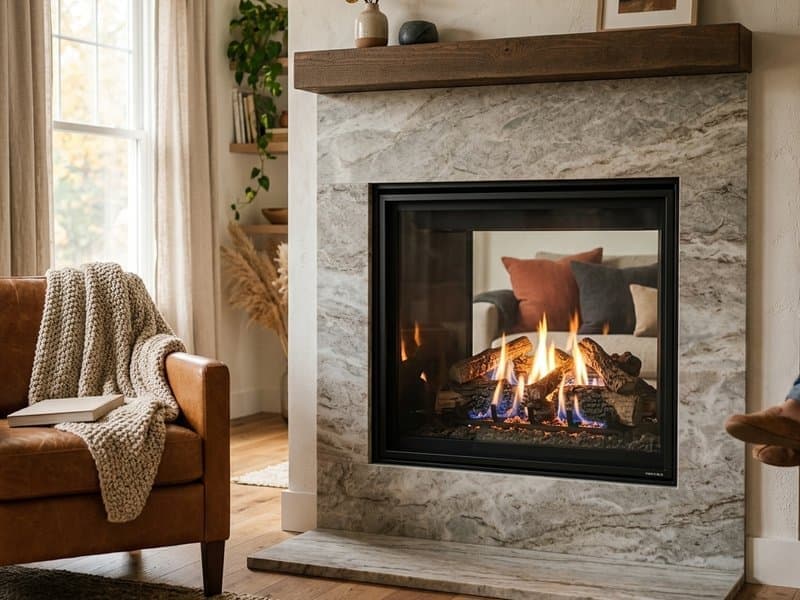
The most common misconception about gas fireplaces, documented across years of homeowner forum threads: "I have a gas fireplace, so I don't need chimney maintenance." This is wrong, and in the specific case of carbon monoxide, it is dangerously wrong.
Here is the direct answer up front: yes, gas fireplaces need annual chimney inspection. They do not need traditional sweeping — gas combustion produces no creosote — but the inspection catches an entirely different set of problems that gas specifically creates. The homeowner who skips gas fireplace inspection for ten years is not saving money; they are accumulating risk in a system whose primary failure mode is an odorless, invisible gas that can kill in hours.
This guide walks through exactly what is different about gas fireplace maintenance, the five specific risks that gas does not eliminate (and sometimes creates), what a gas fireplace inspection actually includes, and when to call a professional immediately rather than waiting for the annual appointment.
The marketing pitch for gas fireplaces emphasizes convenience: no chopping wood, no ash cleanup, no smoke smell, no creosote, no annual sweep. Most of that is true. What the pitch leaves out is that gas creates its own maintenance profile, different from wood but not absent.
| Maintenance Factor | Wood-Burning | Gas |
|---|---|---|
| Creosote buildup | Yes — primary fire risk | None |
| Carbon monoxide risk | Present | Present and often higher |
| Chimney sweep needed | Annually or when buildup is at threshold | Rarely — only if debris or blockage found |
| Chimney inspection needed | Annually | Annually — non-negotiable |
| Liner required | Yes — clay or stainless standard | Yes — aluminum is acceptable |
| Cap needed | Yes | Yes |
| Moisture issues | Present | Often higher — gas produces water vapor |
| Gas leak risk | None | Present — flex lines, valves, connections |
| Pilot/ignition maintenance | N/A | Required |
The critical line in that table is the carbon monoxide row. Wood fires also produce CO, but they also produce a lot of visible smoke and smell when something goes wrong — a backdraft event from a wood fire is obvious within seconds. Gas combustion is nearly invisible. A gas fireplace venting improperly can run for hours producing lethal CO concentrations with no smell, no visible smoke, and no obvious symptom until occupants become confused, sleepy, and eventually unconscious. This is why annual inspection is not optional.
Gas fireplaces need inspection because gas does not eliminate the things that can go wrong with a chimney system — it just changes which ones matter most.
Gas combustion produces carbon monoxide as a normal byproduct. In a properly working system, that CO goes up the flue and out the top of the chimney. In a system where the flue is cracked, the liner has deteriorated, the vent termination is blocked, the heat exchanger has developed a crack (direct vent systems), or the glass seal has failed — the CO ends up in the room instead of the outside air.
CO is odorless, colorless, and tasteless. The first warning signs in humans are headache, nausea, fatigue, and confusion — symptoms that are easy to blame on the flu or a bad night's sleep. Exposure at 400 ppm causes disorientation within an hour; 1,600 ppm causes death within two hours. A malfunctioning gas fireplace can produce these concentrations in a closed room, and the homeowner has no way to detect it without a working CO detector.
The annual inspection catches the conditions that cause CO venting failures before they produce a medical emergency. Skipping the inspection is betting that no cracks, blockages, or seal failures developed in the last 12 months — a bet that costs $100-$200 to avoid.
A blocked flue or vent is the single most common cause of CO incidents in gas fireplaces. Blockage sources include:
Unlike wood fireplaces, where blockages usually cause visible smoke spillage that alerts the homeowner immediately, gas fireplaces will keep burning with a partial or full blockage and push the exhaust somewhere it does not belong. The inspection looks for blockages directly and confirms the vent path is clear.
Gas combustion produces water vapor as a byproduct — a lot of it, actually, compared to wood. That water vapor is slightly acidic (combines with trace compounds in the gas and air to form weak acids) and condenses inside cooler sections of the flue. Over years, that acidic condensation corrodes aluminum liners, eats at masonry mortar joints, and can destroy a liner from the inside out.
Cold-climate gas fireplaces are particularly vulnerable because the flue stays below the dew point for longer periods, producing more condensation per burn hour. An inspection catches liner deterioration before it causes either a leak path for exhaust gases or a structural failure. See chimney-liner-guide for liner material details.
Gas reaches the fireplace through a combination of rigid pipe, flex lines, shutoff valves, and connection points. All of those are mechanical components with finite lifespans. Flex lines can crack from vibration or age. Valve seats degrade. Threaded connections loosen over decades of thermal cycling. Any of those develops into a gas leak.
A gas leak small enough to not set off your nose — below about 25% of the lower explosive limit — can still build up in a closed space and eventually reach combustion concentration. The annual inspection includes a leak check at every connection point and a pressure check where applicable. This is one of the items that most homeowners cannot do themselves safely.
Back to the water vapor: in cold climates especially, the water vapor produced by gas combustion ends up in the masonry stack, freezes in winter, expands, cracks the mortar, cycles through again next winter, and accelerates every other deterioration process. Gas fireplace owners often see masonry degradation faster than wood fireplace owners in the same climate, not slower, because of this condensation issue.
The inspection catches early mortar cracking, flashing failures caused by freeze-thaw damage at the masonry interface, and crown deterioration that gas fireplace owners often assume they are exempt from.
Gas fireplaces are not one product — they are three distinct systems with different maintenance profiles. Understanding which type you have determines what the annual inspection should cover.
The most common modern installation. The appliance is fully sealed behind glass. It draws combustion air from outside through one pipe and exhausts combustion gases through a second concentric pipe, typically terminating horizontally through an exterior wall. No traditional chimney is involved.
Annual inspection priorities:
Cost range for a direct vent inspection: $100-$175.
Older gas fireplaces, or gas logs installed in an existing wood fireplace, often use natural draft venting through an existing masonry or metal chimney. The system relies on the heated flue gases rising up the chimney to pull combustion products out of the house.
Annual inspection priorities:
Cost range for a B-vent inspection: $125-$225 — closer to a standard chimney inspection because the work is nearly the same.
Gas logs or gas fireboxes that burn directly into the room with no venting. Legal in some jurisdictions, banned in others (California, parts of Canada, and increasing numbers of municipalities restrict or prohibit them). These systems rely on an oxygen depletion sensor (ODS) to shut off gas flow if room oxygen drops below safe levels.
Annual inspection priorities:
Cost range for vent-free inspection: $75-$150 — less because there is no chimney to inspect, more because the ODS is a critical safety device that requires careful testing.
| Gas Fireplace Type | Venting | Chimney Involved | Inspection Frequency | Cost Range |
|---|---|---|---|---|
| Direct vent | Sealed, through exterior wall | No | Annual | $100-$175 |
| B-vent / Natural | Through existing chimney | Yes | Annual | $125-$225 |
| Vent-free | None (burns into room) | No | Annual (ODS critical) | $75-$150 |
A proper annual gas fireplace inspection covers the mechanical, combustion, venting, and safety systems. A checklist for what you should see performed on your appointment:
If the technician is in and out in 20 minutes without checking most of those items, you paid for a site visit, not an inspection. See verify-work for how to confirm the work was actually performed.
Gas fireplace manufacturers, installers, and resellers sometimes market the low-maintenance angle aggressively: "No mess, no creosote, no chimney sweep ever!" The first two are technically true — no ash, no creosote. The third is a dangerous oversimplification that reduces a required annual safety inspection to an optional sweeping service.
The line that belongs in every gas fireplace sales brochure but rarely does: "Gas fireplaces do not need chimney sweeping, but they require the same annual inspection as any other combustion appliance — for carbon monoxide safety, not for creosote removal."
When shopping for a sweep or service company, make sure they explicitly list gas fireplace inspection as a service and carry the right credentials — CSIA certification covers gas fireplace inspection, as does NFI Gas Specialist certification. A technician trained only in wood fireplaces may not be qualified to evaluate gas venting, combustion, or CO risks. See find-honest-sweep.
What to do yourself between professional inspections:
Some symptoms are not "wait for the annual appointment" problems. These are "call today, do not use the fireplace until fixed" problems:
Browse 30+ guides, or jump straight to verified operators in your state.

Chimney liner materials compared — clay, stainless 304 vs 316Ti, cast-in-place, aluminum. Costs from $10/ft to $7,000 installed. The full technical reference.

The 10 trust signals that separate honest chimney sweeps from scammers. Vetting questions, verification steps, and how to avoid paying 10x market rate.
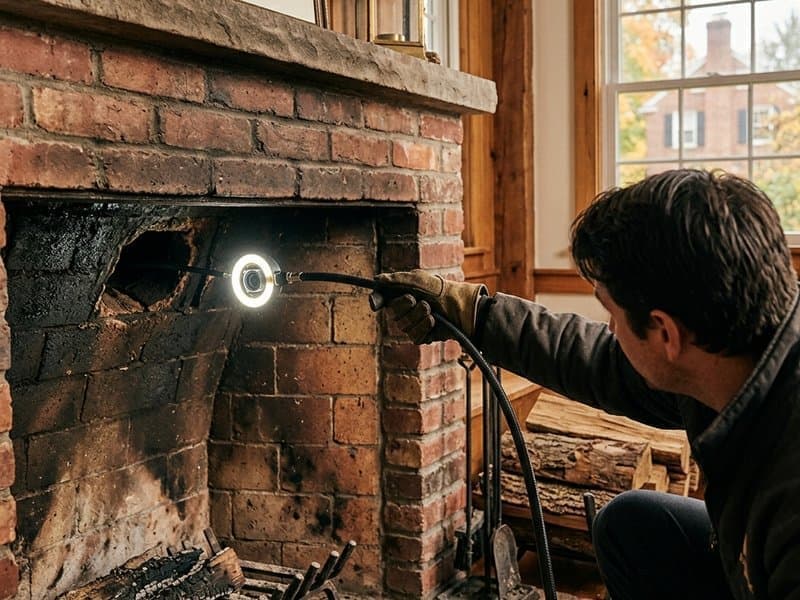
NFPA 211 inspection levels: Level 1 no camera, Level 2 video camera required. Each level includes all lower levels. Sweep durations, scope, scams to avoid.