
Cost Estimator
See what verified chimney sweeps charge in your area for each service.
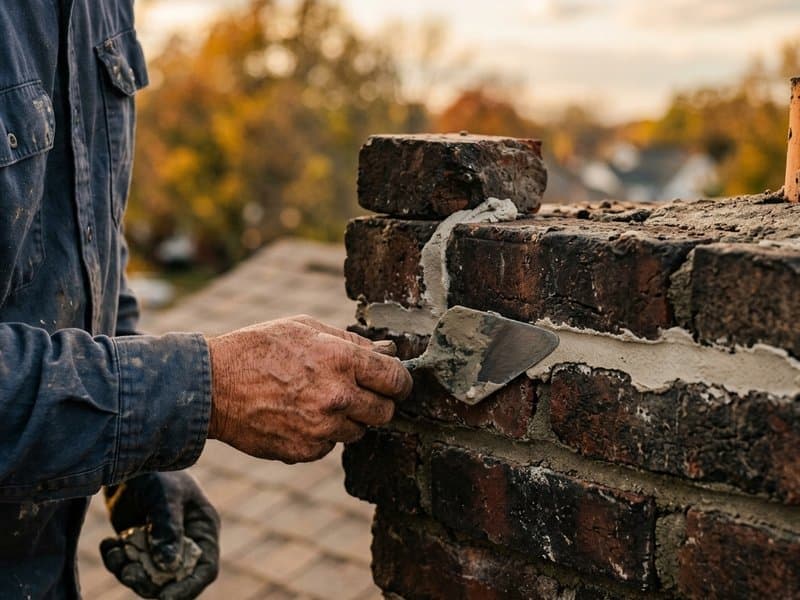
Masonry chimney repair covers everything that maintains the brick and mortar structure of a chimney without requiring a full rebuild. The category includes tuckpointing (replacing mortar joints), brick replacement, spalling repair, crown work, structural crack repair, and chimney stabilisation. Professionally done, masonry repair extends a chimney's functional lifespan by 20-30 years and costs a fraction of rebuild scope. Poorly done, it damages old brick, fails within a few years, and creates worse problems than it solves.
This guide covers the common masonry problems homeowners encounter, how each one is fixed, the typical cost ranges, who should do the work (mason vs chimney sweep), and the critical detail most homeowners never hear about: why the wrong mortar type destroys historic chimneys.
The phrase covers five specific categories of work, each addressing a different type of damage.
Tuckpointing is the removal of deteriorated mortar from brick joints to a depth of approximately 3/4 inch and replacement with fresh mortar. This is the single most common masonry chimney repair and extends chimney life by 25-30 years when done correctly. Full-chimney tuckpointing runs $1,000-$3,000; partial tuckpointing on the worst sections runs $300-$800.
Brick replacement addresses individual or small groups of bricks that have spalled, cracked, or fallen out. The mason removes the damaged brick, cleans the cavity, and installs a matching replacement with fresh mortar. Cost: $25-$75 per brick installed. Larger spalling sections (a square foot or more of damage) run $500-$1,500 depending on extent.
Spalling repair combines brick replacement with surface treatment when the face of multiple bricks has failed. Beyond simple brick replacement, severe spalling may require surface rebuilding with brick veneer, patching compounds, or in some cases recommending rebuild instead of repair. Cost varies widely: $500-$2,500 for moderate spalling repair.
Structural crack repair addresses settling cracks, thermal expansion cracks, and stress fractures in the masonry. Minor cracks (hairline to quarter-inch) can often be injected with epoxy or flexible mortar. Larger cracks may require helical tie bars for reinforcement or stitching pins to restore structural continuity. Cost: $500-$2,000 depending on crack severity and repair method.
Chimney straightening or stabilisation addresses chimneys that have begun to lean away from the house or develop structural movement. This is complex work involving either gradual jacking to realign the chimney, helical anchor installation for structural reinforcement, or in some cases recommending rebuild instead. Cost: $2,000-$6,000 for stabilisation work.
Five specific damage patterns are worth recognising. Each has a specific cause and a specific fix.
Deteriorated mortar joints. Mortar joints that are soft, recessed, crumbling, or missing pieces. Caused by age combined with freeze-thaw cycles — water enters micro-cracks in the mortar, freezes, expands, and progressively breaks the mortar down. This is the most common masonry problem on chimneys 20+ years old. The fix is tuckpointing. Urgency is moderate — joint deterioration progresses slowly but does eventually lead to water intrusion into the chimney structure, liner damage, and interior leaks.
Spalling brick. The face of a brick flakes off, exposing the softer interior of the brick. Caused by water absorbed into the brick freezing and expanding, breaking the surface layer off. Common on the weather-facing side of chimneys in cold climates. The fix depends on extent: individual spalled bricks can be replaced ($25-$75 each); extensive spalling indicates long-term water intrusion and may require waterproofing plus replacement or, in severe cases, partial rebuild. Urgency: moderate — a few spalled bricks can wait a season; a full face of spalling should be addressed promptly.
Cracked brick. Cracks running through individual bricks, often horizontally. Caused by structural stress (settling), thermal expansion (hot-cold cycles), or secondary damage from frozen mortar joints forcing stress into the brick. The fix depends on whether cracks are isolated (individual brick replacement) or systemic (possible structural issue requiring rebuild evaluation). Urgency: moderate — investigate the cause before deciding on scope.
Efflorescence. White crystalline deposits on the chimney exterior. These are mineral salts carried out of the masonry by water moving through the structure. Not damaging in itself, but diagnostic: efflorescence means water is entering the chimney somewhere. The fix is to identify and address the moisture source (cracked crown, failed flashing, missing cap, deteriorated joints), then clean the efflorescence off the surface. Urgency: low for the deposits themselves, moderate for finding and fixing the water source.
Leaning or separation from house. Structural — the chimney has shifted from vertical, pulled away from the house wall, or cracked at its base. Caused by foundation failure, long-term water damage, freeze-thaw cycles at the chimney base, or seismic activity. The fix is stabilisation (helical anchors, chimney straightening) or, in severe cases, rebuild. Urgency: high — a leaning chimney is a collapse risk.
| Problem | Fix | Typical Cost | Urgency |
|---|---|---|---|
| Deteriorated mortar joints (full chimney) | Tuckpointing | $1,000-$3,000 | Moderate |
| Deteriorated mortar joints (partial) | Partial tuckpointing | $300-$800 | Moderate |
| Spalling brick (few bricks) | Brick replacement | $100-$500 | Moderate |
| Spalling brick (larger section) | Spot rebuild with matching brick | $500-$1,500 | Moderate-High |
| Cracked brick (isolated) | Individual brick replacement | $25-$75 per brick | Low-Moderate |
| Efflorescence | Identify moisture source + clean | $200-$1,000 | Low-Moderate |
| Structural crack (minor) | Epoxy injection or flexible mortar | $300-$800 | Moderate |
| Structural crack (major) | Helical tie bars or stitching | $500-$2,000 | High |
| Chimney straightening/stabilisation | Jacking + helical anchors | $2,000-$6,000 | High |
Tuckpointing deserves its own section because it is by far the most common masonry chimney repair and the one most often misunderstood.
The process: a mason removes old deteriorated mortar from the joints between bricks using a mortar rake, grinder, or hand chisel, cutting back to a depth of approximately 3/4 inch. The cavity is cleaned of dust and loose material. Fresh mortar is then packed into the joint using a pointing trowel, struck with a profile matching the existing joint style (concave, V-joint, weathered, raked), and allowed to cure.
Properly done tuckpointing:
Poorly done tuckpointing:
The visual quality of tuckpointing work is a useful proxy for its durability. Tuckpointing that looks clean, even, and colour-matched is usually structurally sound. Tuckpointing that looks patchy, uneven, or obviously different from the surrounding original mortar is often shortcut work.
Chimney sweeps and masons have overlapping but distinct specialties. Understanding the difference prevents hiring the wrong trade for the job.
Chimney sweeps are trained primarily in cleaning, inspection, liner work, cap installation, and minor crown work. Their CSIA certification exam covers inspection protocols, creosote chemistry, and flue dynamics — not structural masonry. Many chimney sweep companies do offer masonry repair services, and some are excellent at it, but the training path does not emphasise masonry.
Masons are trained primarily in brick, block, and stone structural work — tuckpointing, spalling repair, structural crack repair, and full rebuilds. A journeyman mason has years of experience with mortar types, brick matching, and structural repair. Masons typically do not handle liner work, cap installation, or chimney cleaning.
The practical rule for chimney work:
When a chimney sweep quotes major masonry work — full chimney tuckpointing, structural repair, rebuild — ask whether they have in-house masons or subcontract the work. A sweep company that subcontracts masonry will usually quote a higher price than hiring a mason directly (they add margin on top of the mason's fee). A sweep company with in-house masons is fine; a sweep company whose sweep technicians are also doing the masonry themselves is worth investigating — do they have actual masonry training and experience?
For major masonry projects, a direct comparison quote from a general masonry contractor is almost always useful. The mason may quote significantly less and have specifically-relevant experience.
The detail most homeowners never hear about and the one that causes the most expensive masonry repair failures.
Mortar is not a single standard product. Different formulations have different properties — strength, flexibility, vapor permeability. Using the wrong mortar for the masonry causes progressive damage.
Pre-1920 chimneys were built with lime mortar — a soft, flexible, vapor-permeable mortar made from hydrated lime, sand, and water (sometimes with a small amount of Portland cement as a modern additive). Lime mortar accommodates thermal expansion and small structural movement without cracking. It is softer than the brick it binds.
Modern Portland cement mortar (Type N, Type M, Type S) is harder, stronger, and less flexible than lime mortar. It is appropriate for modern brick and for load-bearing structural applications.
When modern Portland cement mortar is applied to a pre-1920 chimney with old soft brick, a specific failure pattern occurs. Thermal expansion and minor structural movement stress — which the original lime mortar would have absorbed — cannot be absorbed by the harder cement mortar. The stress is transferred to the weakest element in the wall, which is now the old soft brick instead of the joint. The brick cracks. Once cracked, old brick deteriorates rapidly from water intrusion, and the chimney starts showing widespread brick damage within 5-10 years.
The correct approach for historic chimneys: use Type O lime mortar or a historic-compatible formulation (some manufacturers sell "historic" or "restoration" mortar specifically for this purpose). A mason with experience in historic restoration will know this automatically. A general mason doing their first historic chimney may not.
Ask before the work begins: "What mortar type are you using, and why is it appropriate for my chimney?" The answer should be specific and reference the chimney's age. An operator who shrugs and says "standard mortar" is about to damage your chimney.
A Level 1 inspection, which every chimney should receive annually, covers exterior masonry condition as one of its standard line items. The inspector should document:
A sweep's inspection report that notes "mortar joints need tuckpointing" or "spalling on south face" is giving you actionable information. A report that just says "chimney looks fine" without addressing masonry condition explicitly is incomplete. Ask specifically about each of the above items if they are not documented in the written report.
For major masonry work decisions — tuckpointing the entire chimney, repairing structural cracks, deciding between repair and rebuild — a dedicated masonry consultation is often valuable. A mason's evaluation for a masonry-specific problem is usually more detailed than a sweep's general inspection.
Masonry work requires temperatures above 40°F for mortar to cure correctly. Below that threshold, water in the mortar mix freezes before the cement hydrates, and the final strength of the joint is compromised.
Practical implications:
Plan masonry work well ahead. A tuckpointing project scheduled in July and done correctly is better than the same project rushed in October under weather pressure.
Some masonry repair is genuinely DIY-possible; most isn't.
Reasonable DIY scope:
Required tools: mortar rake, pointing trowel, grout bag, mortar mix (matched to chimney type), safety glasses, dust mask, ladder appropriate for the height. Total tool cost: $50-$150.
Not DIY scope:
The rule of thumb: if the work is accessible from a step ladder and addresses a small well-defined section, DIY is reasonable. If the work requires a tall extension ladder, roof access, or more than a day's labour, hire a professional.
Browse 30+ guides, or jump straight to verified operators in your state.
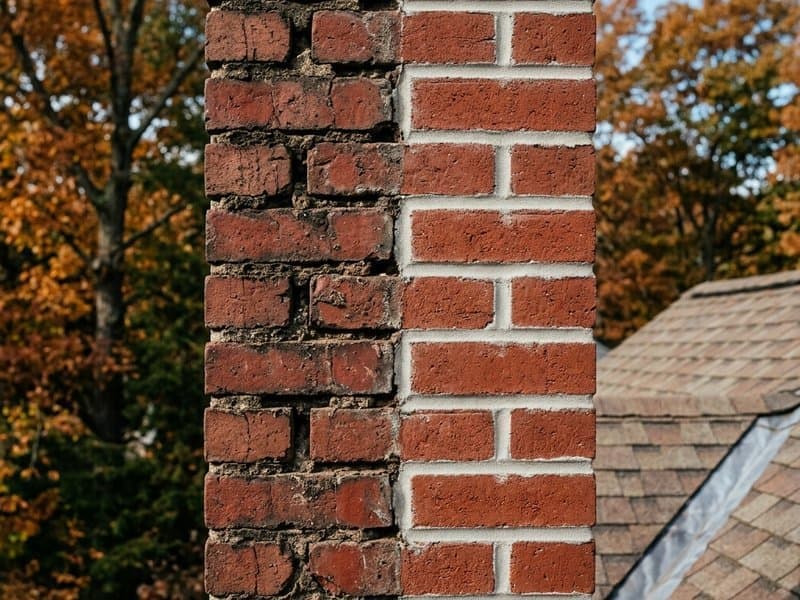
Tuckpointing chimney guide: what it is, realistic cost ranges, how to spot bad mortar matching on old brick, and the process step by step.
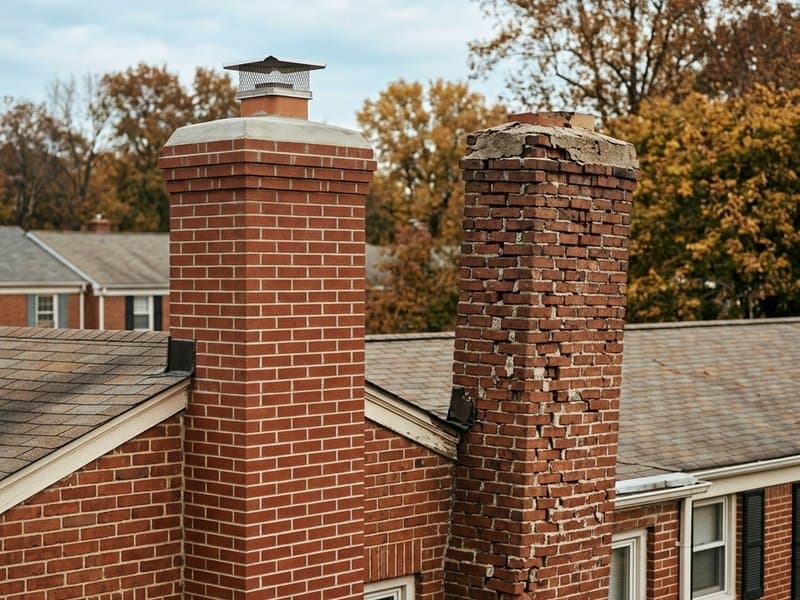
Chimney rebuild costs $3,000-$25,000. When you actually need a rebuild vs repair, with scope, typical pricing ranges, and how to compare quotes.
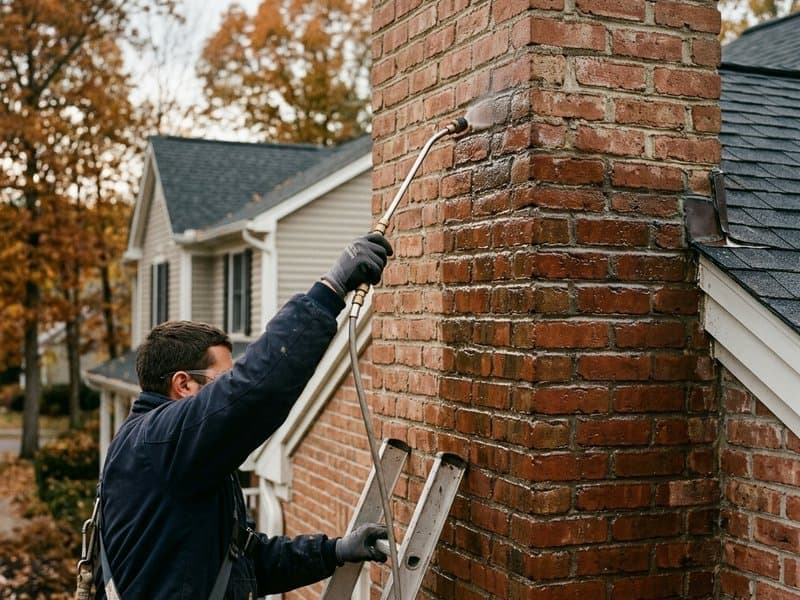
Chimney waterproofing cost, when it's worth it, the vapor-permeable vs sealer distinction, and why Thompson's Water Seal damages brick chimneys.